AIDE Card Game
AIDE Card Game
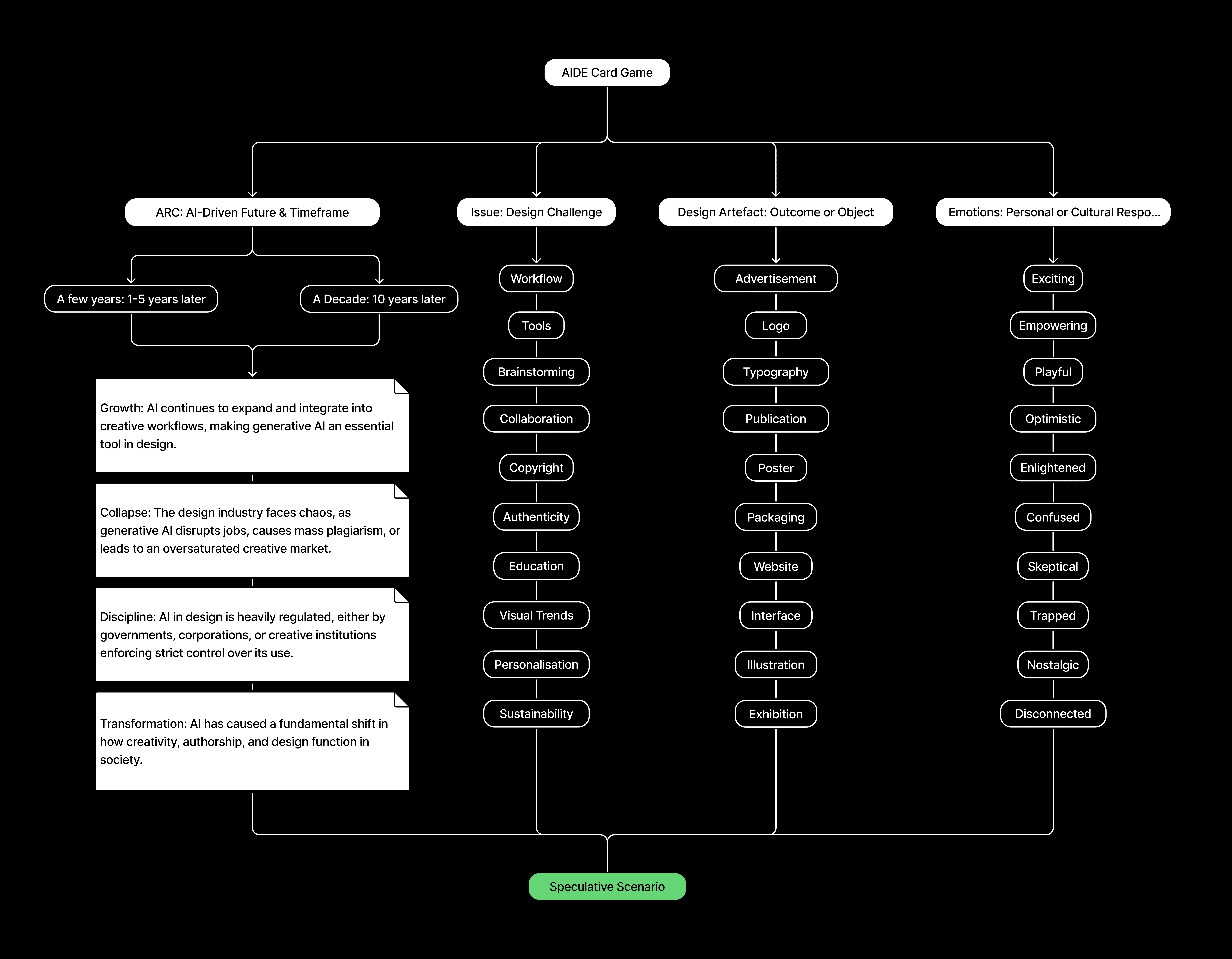
The AIDE Card Game (Arc, Issue, Design Artefact, Emotion) is a speculative design tool created to help designers think critically and creatively about the future of AI in design. It is used in workshops to generate imaginative scenarios that explore how AI might shape creative workflows, authorship, and ethics.
The AIDE Card Game (Arc, Issue, Design Artefact, Emotion) is a speculative design tool created to help designers think critically and creatively about the future of AI in design. It is used in workshops to generate imaginative scenarios that explore how AI might shape creative workflows, authorship, and ethics.
The World Economic Forum Future of Jobs Report 2025 ranks graphic design as the 11th fastest-declining job. This decline is linked to two main factors: (1) generative AI tools that can now perform many design tasks, and (2) easy-to-use online platforms that allow non-designers to produce visual content. However, despite their growing use, current generative AI tools do not fully support the needs of professional designers. Designers who have experimented with these tools often encounter four common challenges:
Speculative Scenario Crafting
Speculative Scenario Crafting
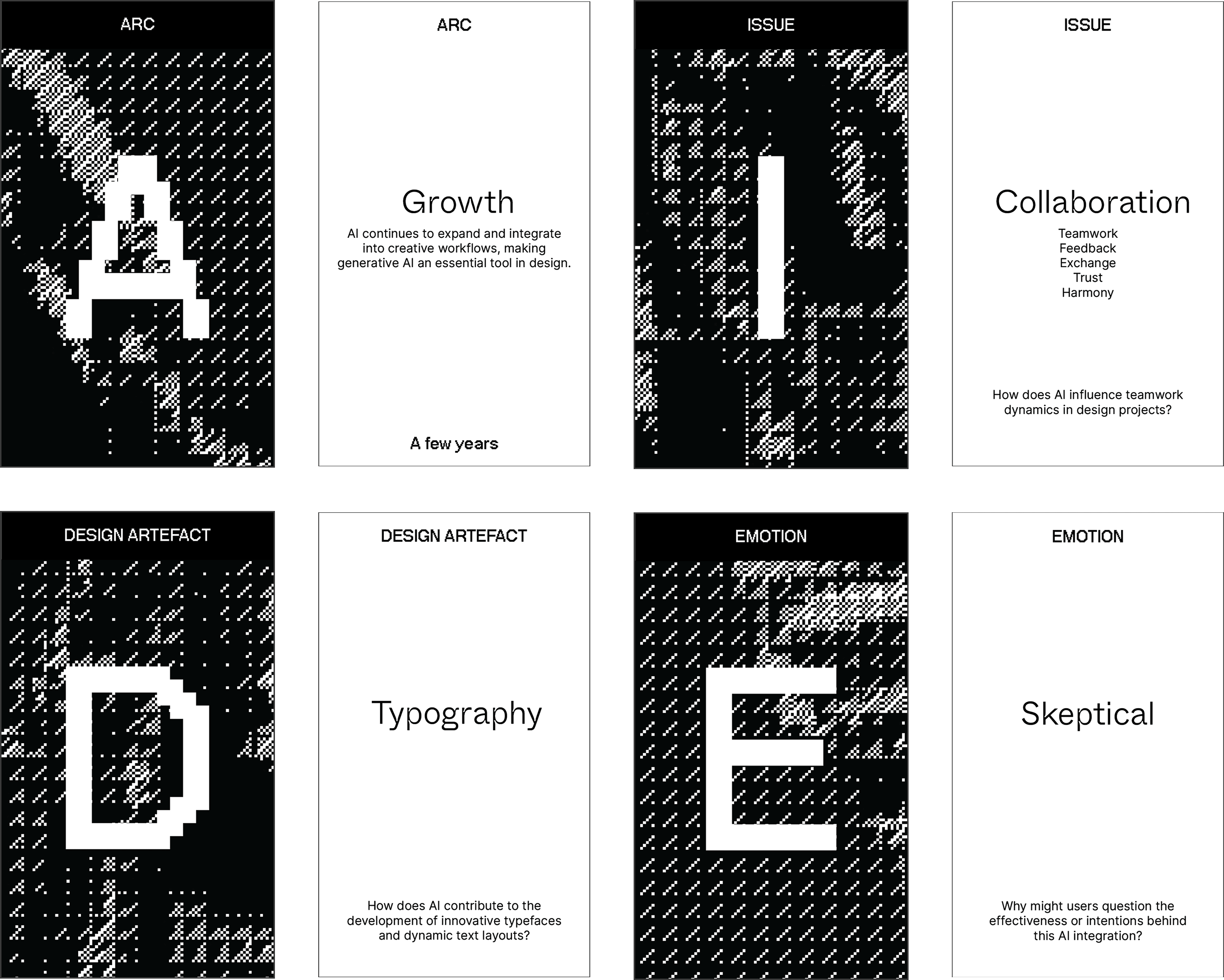
AIDE is inspired by The Thing From The Future by Stuart Candy and Jeff Watson, and Jim Dator’s four futures archetypes. In AIDE, the Arc suit adapts Dator’s generic images of the future—Growth, Collapse, Discipline, Transformation—to set the time horizon and world conditions for each scenario.
Each round, participants draw one card from each of the four categories:
Arc – sets the overall context and time frame for the future scenario.
Issue – identifies a challenge, tension, or opportunity within design practice.
Design Artefact – specifies the creative output or system that exists in this imagined world.
Emotion – captures society’s emotional response to the artefact.
Using these cards, participants connect the elements to create a future design scenario. They describe the artefact in detail, sketch it, and discuss its societal, ethical, and industry implications.
AIDE is inspired by The Thing From The Future by Stuart Candy and Jeff Watson, and Jim Dator’s four futures archetypes. In AIDE, the Arc suit adapts Dator’s generic images of the future—Growth, Collapse, Discipline, Transformation—to set the time horizon and world conditions for each scenario.
Each round, participants draw one card from each of the four categories:
Arc – sets the overall context and time frame for the future scenario.
Issue – identifies a challenge, tension, or opportunity within design practice.
Design Artefact – specifies the creative output or system that exists in this imagined world.
Emotion – captures society’s emotional response to the artefact.
Using these cards, participants connect the elements to create a future design scenario. They describe the artefact in detail, sketch it, and discuss its societal, ethical, and industry implications.
AIDE is inspired by The Thing From The Future by Stuart Candy and Jeff Watson, and Jim Dator’s four futures archetypes. In AIDE, the Arc suit adapts Dator’s generic images of the future—Growth, Collapse, Discipline, Transformation—to set the time horizon and world conditions for each scenario.
Each round, participants draw one card from each of the four categories:
Arc – sets the overall context and time frame for the future scenario.
Issue – identifies a challenge, tension, or opportunity within design practice.
Design Artefact – specifies the creative output or system that exists in this imagined world.
Emotion – captures society’s emotional response to the artefact.
Using these cards, participants connect the elements to create a future design scenario. They describe the artefact in detail, sketch it, and discuss its societal, ethical, and industry implications.
How it works
How it works
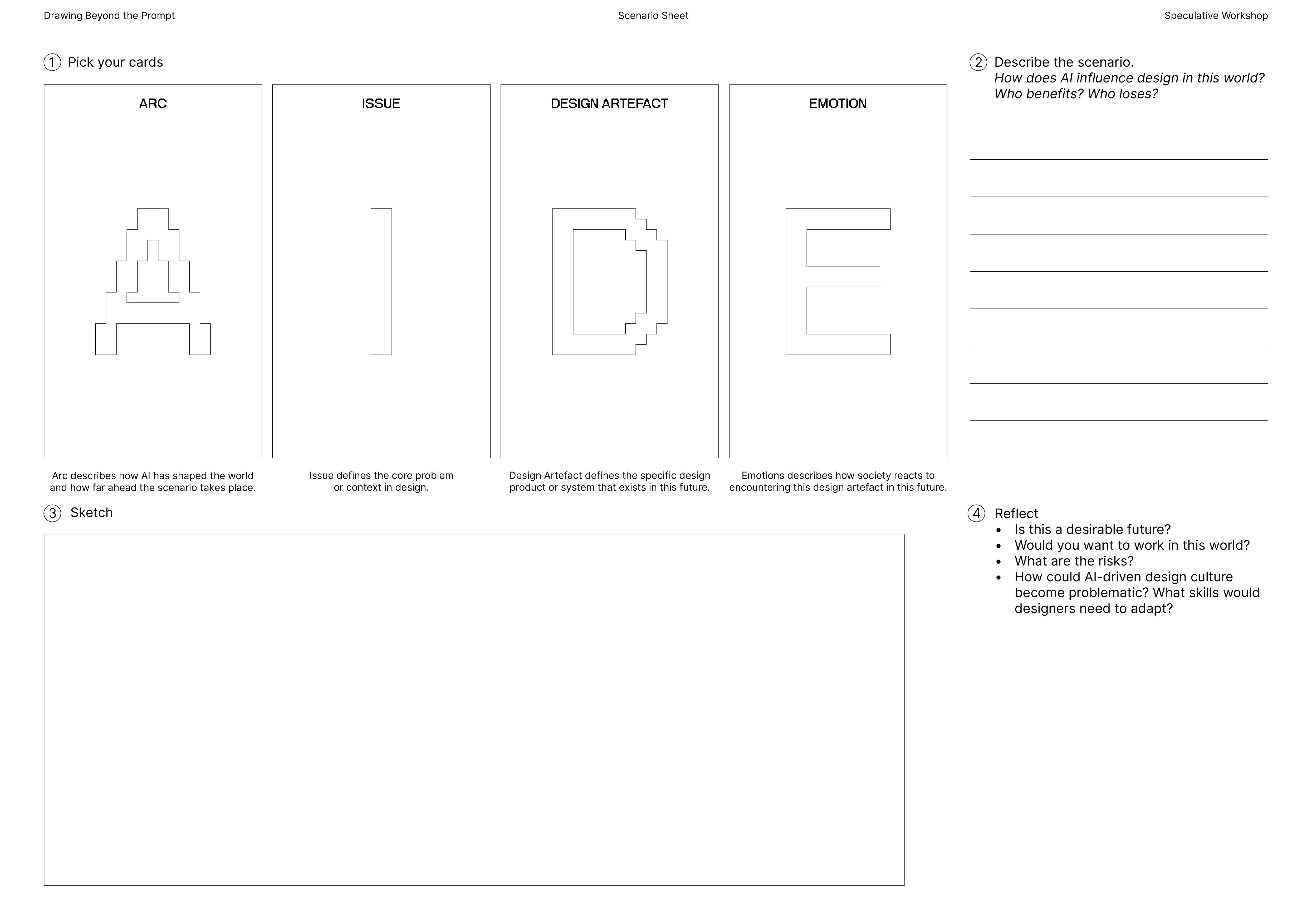
Draw one card from each category A, I, D, E.
Connect the four elements into a scenario about AI and design.
Sketch the artefact and describe who benefits, who loses, and why.
Reflect: Is this a future you’d want? What risks emerge?
Draw one card from each category A, I, D, E.
Connect the four elements into a scenario about AI and design.
Sketch the artefact and describe who benefits, who loses, and why.
Reflect: Is this a future you’d want? What risks emerge?
What it’s for
What it’s for
Push thinking beyond current tools and constraints.
Create a shared language for discussing AI’s impact on workflows, authorship, and ethics.
Generate visualised scenarios and narratives that may be used in research, teaching, and strategy.
Push thinking beyond current tools and constraints.
Create a shared language for discussing AI’s impact on workflows, authorship, and ethics.
Generate visualised scenarios and narratives that may be used in research, teaching, and strategy.